
"The satisfaction of a little girl saying 'this was the best birthday ever' – I don't know how to put a dollar sign on that. But it feels amazing to put something out there into the world that people are excited about."
Eric Anderson, Teal Barn Company
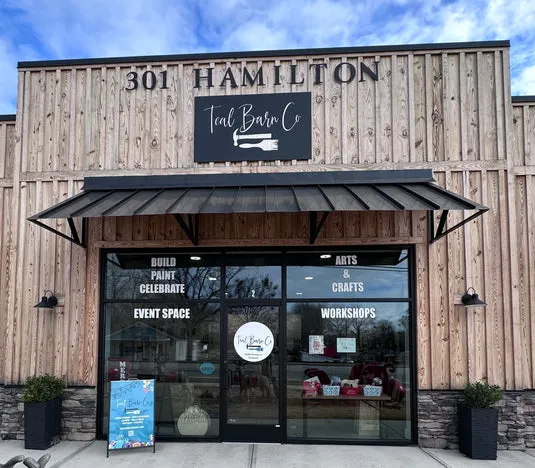
How Eric and Valerie Anderson Turned a Soccer Field Dream Into a Community Maker Studio
Eric Anderson
Quick Facts
Location
Business Type
Independent
In Business Since
Customer Since
Employees
From the Sidelines to the Studio
Eric Anderson spent nearly 25 years building a career at Home Depot. It was stable, structured, and predictable: everything a corporate job is supposed to be. But somewhere in the back of his mind, a quieter question kept surfacing:
Wouldn’t it be cool if we could do our own thing?
That question wasn’t just Eric’s – his wife Valerie had been an entrepreneur at heart for years, always tinkering, always creating. The couple had flirted with the idea of owning a business for a long time; exploring home décor shops, looking into franchises, running the numbers on a dozen different concepts. Nothing quite clicked.
Then one evening, on the sidelines of a soccer field, the conversation shifted. They talked about what was missing in their small West Georgia community. No movie theater. No real hands-on entertainment. Nowhere to go on a Friday night and make something. That gap, they realized, was an opportunity.
“There’s a dearth of that,” Eric said. “There’s not a lot in our community to go out and do for fun. We thought we could take a passion we have around making things and fill that with something people could go out and do and have fun.”
With that, Teal Barn Company was born. The name? Valerie’s favorite color – teal – and her love of the barn aesthetic. Simple, warm, and entirely them.
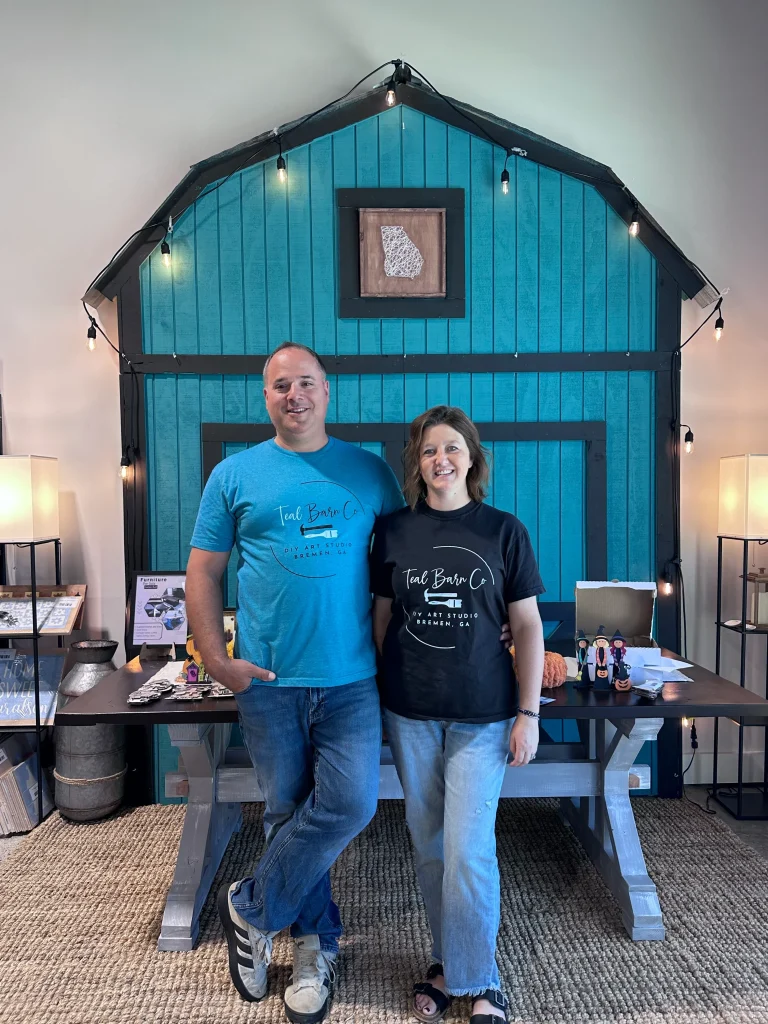
Come Make Something Awesome
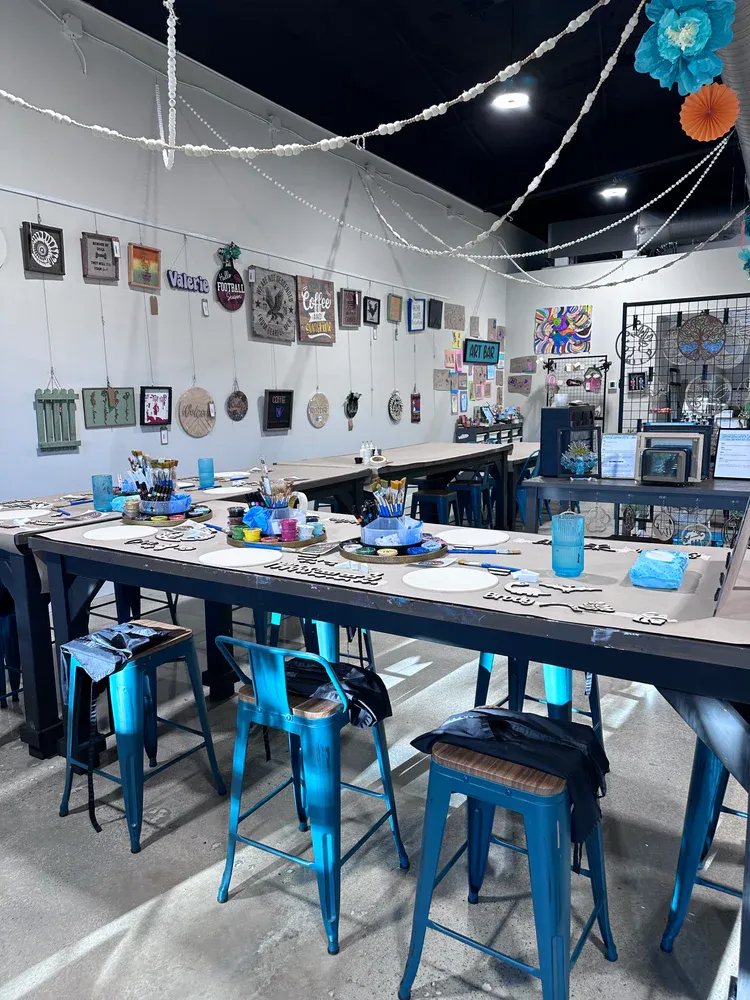
Teal Barn isn’t a paint-and-sip. It isn’t a ceramics studio. It isn’t a laser cutting shop. It’s all of those things and then some.
The concept is simple: create a space where people come together, get their hands dirty, make something unique, and go home proud of it. “Leave the mess somewhere else,” as Eric puts it.
On any given visit, guests might find themselves doing pyrography (wood or hat burning), pouring epoxy and glass projects, working with a laser cutter, painting on ceramics or wood, or trying a technique they’ve never seen at Hobby Lobby. At any one time, Teal Barn carries about ten distinct experiences and the lineup is always evolving.
“If we were just hat people,” Eric said with a laugh, “by the end of year one my hope would be everybody in the community would have a hat but that would sort of be the end of it.”
The model also extends well beyond the studio walls. Teal Barn sells digital design files, DIY kits for customers who can’t make it in person, and wholesale supplies for other makers at local markets and craft fairs. It’s a full ecosystem – from the hands-on experience, to the shippable kit, to the digital download.
“We’re looking at the whole ecosystem of making and crafting,” Eric explained, “and asking where we can play in all of it.”
The Hard Lesson of Doing Too Much
Building something this expansive came with a learning curve.
Early on, the biggest challenge wasn’t finding customers. It was focus. With so many directions to explore and so many products to try, the message to the community got blurry. What was Teal Barn, exactly? What should someone expect when they walked through the door?
“Trying to do everything really dilutes the message,” Eric said. “It was hard to get seen. I had rose-colored glasses about opening in a small town and thinking we’d be the new kid on the street and everybody would fall in love with us immediately.”
They also discovered that open studio hours – just being “open from ten to six and hoping people wander in” – didn’t work in their location. With limited foot traffic on their road, it was a model that burned hours without generating revenue.
So they pivoted. Teal Barn shifted from open retail to an event-driven model: birthday parties, ladies’ nights, curated project evenings, corporate offsite experiences. Instead of staffing for forty hours a week, they now book intentional blocks of time, accept what fits, and build the schedule around the business rather than the other way around.
“It’s a lot more manageable when we accept what comes in, block it off, and aren’t just trying to staff sixty hours a week when nobody’s walking in,” Eric said.
Community Is the Marketing Strategy
Once the event-based model clicked, so did their approach to growth.
Online content has been one engine. Not hard-sell posts, but genuine storytelling. Videos of the making process. Project ideas people can try at home. A brand personality that says, we love this stuff, and if you’re curious, come hang out with us.
But the bigger engine has been local partnerships.
One of their earliest off-site events was at a winery: a classic sip-and-paint format, but with Teal Barn’s signature twist of unique projects and hands-on guidance. It was a hit. More importantly, it introduced them to an audience that had never heard of them, through a business with ten years of built-up customer relationships.
“If you partner with a business that’s ten years older than you,” Eric said, “their mailing list is a lot more impressive than yours. And as long as you take excellent care of their customers, they’re gonna keep introducing you to those folks.”
That off-site model has since become a core part of how Teal Barn operates – breweries, boutiques, corporate team events. They also plugged into the Harrelson County Chamber of Commerce early, joined the board of directors, and found a level of community support that genuinely surprised them.
“I couldn’t thank them enough,” Eric said. “They’ve been amazing.”
A Partnership Built at Home
Running a business is hard. Running a business with your spouse is a different kind of adventure entirely.
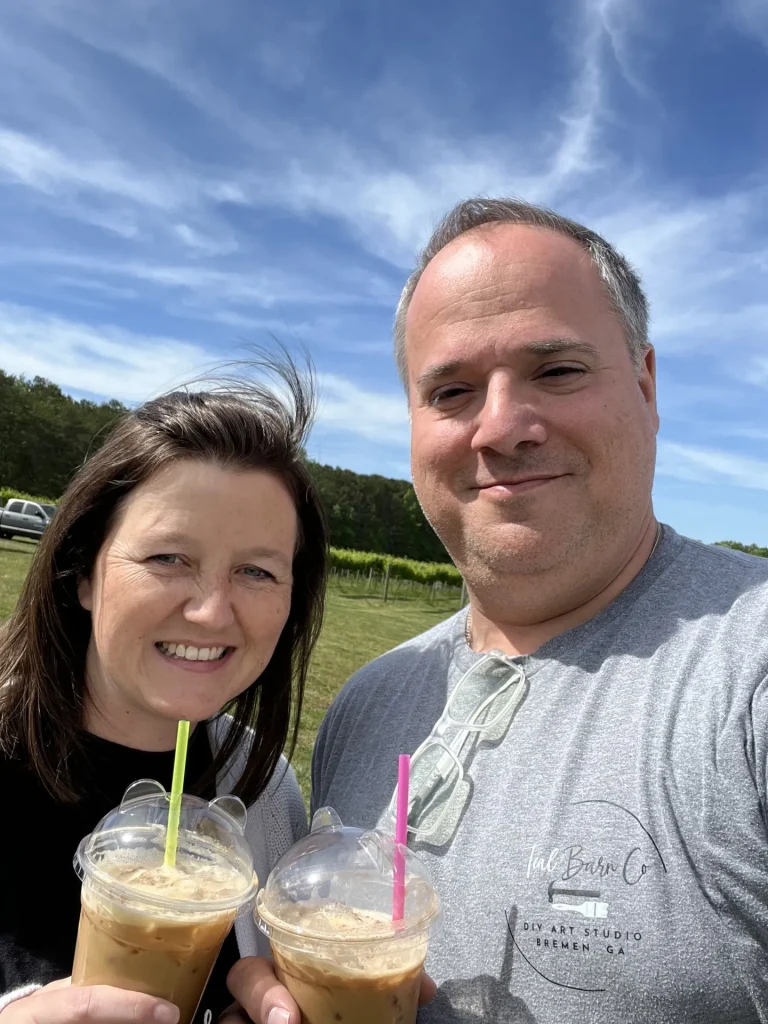
Before Teal Barn, Eric and Valerie had never worked together day-to-day. Now they share everything: the studio, the schedule, the wins, the headaches. Eric is quick to say it’s been one of the best parts of the whole experience.
“Getting to spend this much time with my wife is a dream come true,” he said. “Seeing her up close and personal, doing most of the heavy lifting on the website, the design, the marketing – it’s been amazing to be a part of.”
But working together also required some hard-won clarity about who does what. Early on, both of them were pulling in different directions such as Eric exploring pottery, Valerie deep in woodcrafting, none of it complementary. The supply chains didn’t overlap. The skills didn’t stack. Progress stalled.
The fix was simple, but not easy: pick lanes.
Valerie became the chief merchant of Teal Barn – the one who selects products, designs experiences, and knows intuitively what guests can actually accomplish in a two-hour session. Eric focuses on the backend: pricing, margins, point of sale, the math that makes all the creativity sustainable.
“She’s better at understanding what people can do in a setting where they don’t have a lot of experience,” Eric said. “And one of us had to go do the not-fun stuff so the other could do the fun stuff.”
The result is a partnership that works – not in spite of the closeness, but because of it.
Trading the Predictable for the Purposeful
Life before Teal Barn had a certain rhythm. Eight to five. Paid vacation. A lunchroom on the main floor. Weekends off.
Life now looks different. Birthday parties on Saturdays. Evening events mid-week. A schedule shaped by demand, not by a clock. And instead of predictable paychecks, a business that ebbs and flows – but is entirely theirs.
Eric is honest about the trade-offs. Nearly 18 months in, with the business approaching profitability and their first non-family hire on the horizon, he describes reaching back to a “bridge job” to extend the runway while Teal Barn grows. That’s the reality of building something from scratch in a small community. There’s no shortcut.
But when a little girl walks out of a birthday party declaring it the best day of her life? That math is harder to argue with.
“The level of satisfaction in building something – hard to put a number on that,” Eric said. “Hard to say how many Saturdays it’s worth.”
What's Next for Teal Barn
The dream is bigger than one studio in West Georgia.
Eric and Valerie are already thinking about a second location and eventually, maybe a franchise model for the concept they’ve spent nearly two years refining. They explored franchising before starting Teal Barn and walked away, deciding they wanted the freedom to tinker and experiment. Ironically, all that tinkering is exactly what a good franchise is built on.
“Once we get through all the hard stuff,” Eric said, “I believe unit number two is incrementally easier to get off the ground. And if we get two or three going that feel repeatable, then maybe I get more serious about the idea of franchising.”
For now, the focus is on finishing the thought: hiring their first outside team member, strengthening the online product catalog, and building the kind of model that works in one community before they hand it to someone else.
They’re not rushing it. They’re building it right.
The Guidant Connection
Eric found Guidant Financial through Jeremy Ames’ Don’t Quit Your Daydream newsletter. He was drawn in by what he described as its “concise simplicity and consistency.” What he didn’t expect was the genuine human response on the other end.
“I responded to a prompt about small business owners and was absolutely blown away that somebody actually replied and it was a real human conversation,” he said. “There’s a lot of not-real out there. The fact that there have been three very real interactions has been quite impressive.”
As Teal Barn grows and expansion financing becomes a near-term reality – whether through retirement funds, home equity, or small business lending – Eric knows where to turn. Guidant’s team specializes in helping small business owners navigate exactly those decisions, including the 401(k) Business Financing (ROBS) solution that allows entrepreneurs to invest retirement savings into their own business without early withdrawal penalties or taking on debt.
For Eric and Valerie, that next chapter is coming. And when it does, they’ll have the support they need to take it.
Want to See More?
If Eric and Valerie’s story inspires you and you’re considering entrepreneurship, our team at Guidant Financial specializes in helping aspiring business owners navigate their financing options with clarity and confidence. Discover how our 401(k) Business Financing (ROBS) solution can help turn your vision into reality. For more success stories and expert insights, visit our YouTube channel: https://www.youtube.com/@Dont-Quit-Your-Daydream
Ready to start your dream business?
We can help you with the first step. Pre-qualify today for Small Business Financing.