Business Types/Structures
What Is a Business Structure and Why Does It Matter?
Legal Structure
Tax Structure
Your Business Structure: Filing Taxes and Assessing Legal Liability
Sole Proprietorship
Partnership
The two primary types of partnerships are limited partnerships (LPs) and limited liability partnerships (LLPs). In both types, partners have limited liability, which means they are not responsible for any liabilities totaling more than their investment in the partnership.
Limited Liability Company
A limited liability company (LLC) is a legal structure that can be owned by one or more entities, including individuals and businesses. Despite its name, an LLC is not recognized as a separate tax entity by the federal government and must adopt a tax status like a sole proprietorship, partnership, S Corp, or C Corp for tax purposes. Contrary to common belief, most LLCs choose to be taxed as S Corps rather than partnerships. Profits are not automatically subject to self-employment tax unless the LLC is taxed as a sole proprietorship or partnership.
Members can deduct their share of the losses on their tax returns if the LLC incurs losses. Additionally, if an LLC has employees who are not members, it is responsible for paying payroll taxes on their behalf. Members of an LLC are shielded from personal liability for debts or legal actions against the company.
Corporations
C Corporations Versus S Corporations
If you incorporate a business, it is a C Corporation (C Corp) unless you specify otherwise. C Corps are subject to what is sometimes termed “double taxation.” The profits are taxed and must be reported on the company’s tax returns. In addition, if a C Corp issues dividend-paying stocks, the dividends are also taxed. Each individual shareholder must report the dividends (and proceeds or losses from the sale of any stock) on their personal tax returns.
Legally, anyone can own shares in a C Corp, and the number of shares outstanding is unlimited.
S Corporations (S Corps) are quite different. S Corps do not pay taxes on their profits. Instead, they pass through both profit and loss to their shareholders, who report it on their individual tax returns. A dividend-like reserve paid to S Corp shareholders from net income and is generally not taxed. S Corps are restricted to 100 shareholders and all of them must be U.S. citizens.
If you want your business to become an S Corp, you have to file a Form 2553 to do so with the IRS.
All owners of corporations have limited liability.
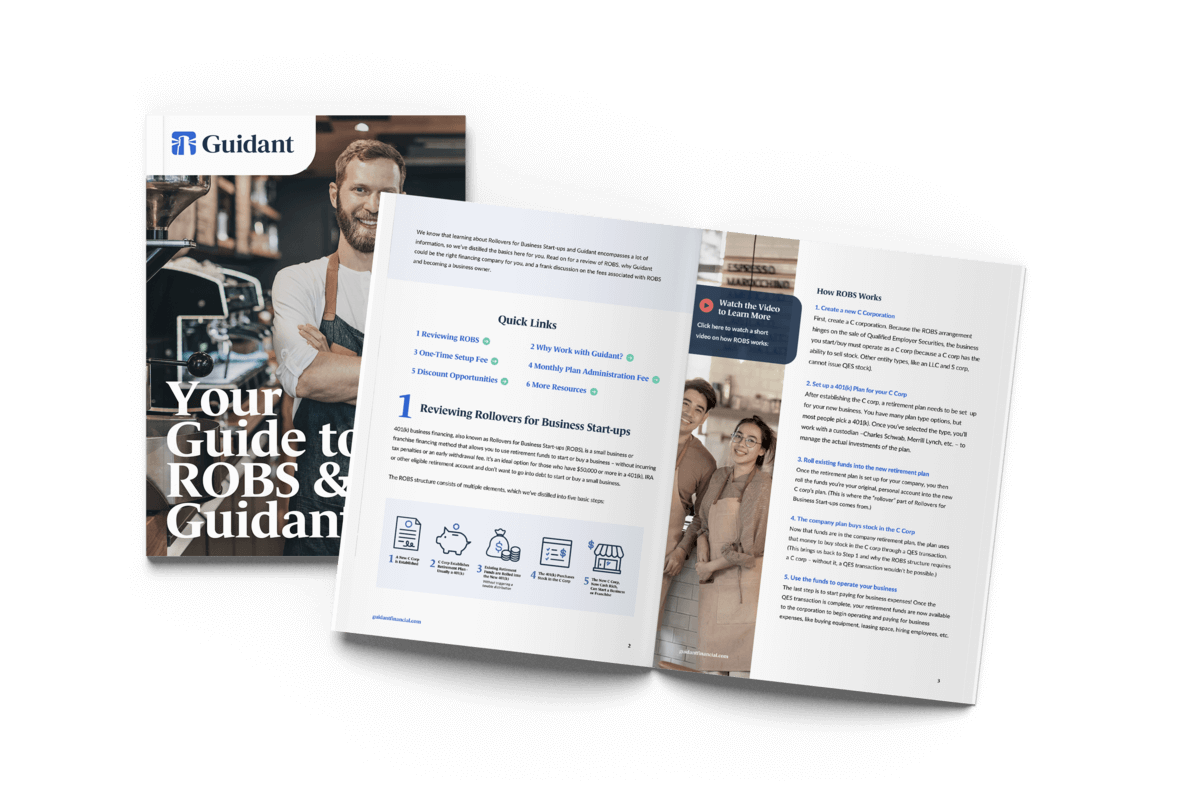
C Corporations and Rollovers for Business Startups (ROBS)
ROBS involves rolling over funds from a qualified retirement plan, such as a 401(k) or Individual Retirement Account (IRA). Usually, withdrawing funds from these tax-advantaged accounts triggers taxation. If you are not yet 59½ years old, the IRS levies a tax penalty of 10 percent in addition to taxing the amount withdrawn at your current rate. If you are 59½ or over, you won’t have to pay a penalty, but you will have to pay taxes on the amount – which can severely lessen the amount you have available for your business.
The ROBS method, however, involves starting a new C Corp with a new tax-advantaged retirement plan, such as a 401(k), open to all employees. At that point, your qualified retirement funds are rolled over into the new retirement plan. Those funds then buy stock in the new C Corp, which can be used for funding the business.
The ROBS method means that your retirement funds used in this way won’t be taxed at all. This enables you to fund your business with money that is both interest- and tax-free.
Tax Year Selection
While all businesses can theoretically choose their tax year, in practice, the flexibility to choose between a calendar year and a fiscal year is primarily available to C Corps. Most other business entities are automatically defaulted to a calendar year end, and changing to a fiscal year end can be challenging. The IRS requires non-C Corp entities to file IRS Form 1128, Application To Adopt, Change, or Retain a Tax Year, to make such a change, which often necessitates a substantial justification, such as significant seasonality that aligns poorly with the calendar year.
For most businesses, the tax year ends on December 31, and tax returns are due by April 15 of the following year. C Corps, however, possess the unique ability to easily opt for a fiscal year that best matches their business cycles.
Consolidated Tax Returns
Pre-Qualify Today!