ROBS – Rollovers for Business Startups – is one of the most powerful ways to fund a business without taking on debt. But every financing arrangement eventually runs its course. Whether your business is thriving and you’re ready to sell, you’re considering a different entity structure, or you’re navigating a difficult closure, there may come a time when you need to exit your ROBS plan.
The key thing to understand: you can’t simply walk away. Exiting ROBS the right way matters – skip the required steps and you could face IRS fines and Department of Labor (DOL) penalties. Here’s what the process looks like, and how to navigate it without the headaches.
A Quick Recap: How ROBS Works
If you’re already using ROBS, you know the basics: but a quick recap helps set the stage for understanding what you’re actually unwinding.
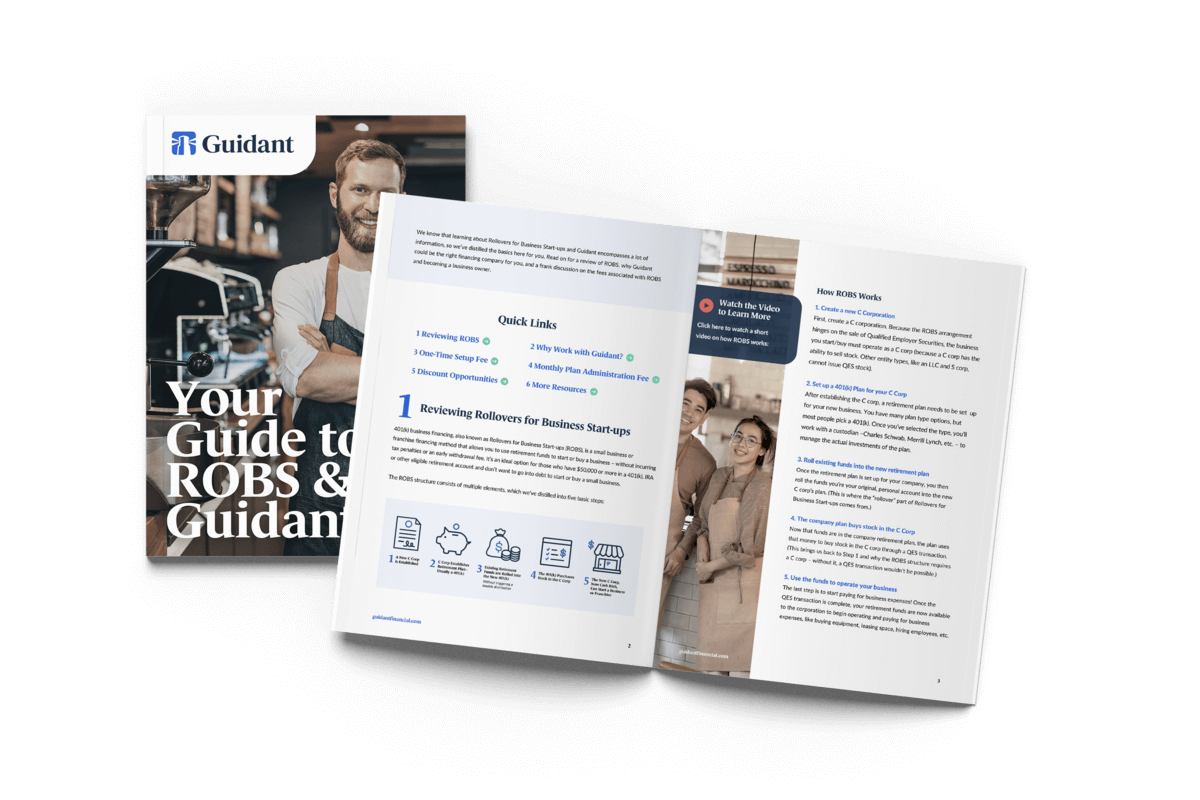
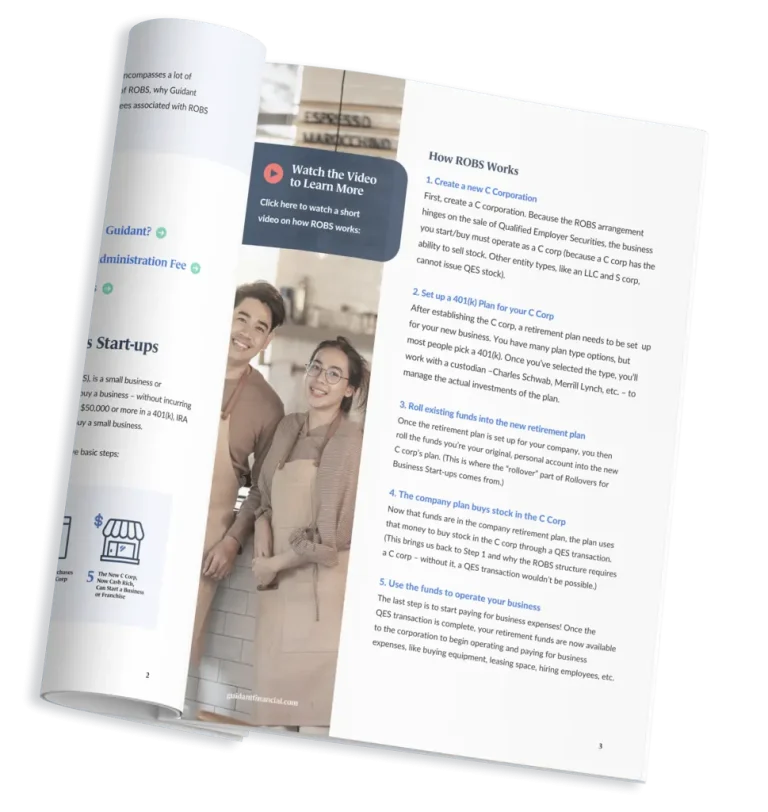
ROBS works by rolling your existing retirement savings into a new employer-sponsored 401(k) plan tied to a C Corporation (C Corp) you establish. That retirement plan then uses those funds to purchase stock in your C Corp, giving you access to capital without triggering early withdrawal taxes or penalties. The result: debt-free business financing you control.
The IRS actively monitors ROBS arrangements for compliance and that oversight doesn’t end when you decide to exit. Your ROBS plan remains active in the eyes of the IRS until you formally close it, which is exactly why a structured exit plan matters.
For a full breakdown of how ROBS works, see our Complete Guide to ROBS.
Wondering if ROBS made sense to begin with? Here’s an honest look at the pros and cons of ROBS and a deeper dive into whether using your retirement funds for a business is the right call for your situation.
Why Business Owners Exit ROBS
There’s no single “right” reason to exit a ROBS plan. It usually comes down to one of four scenarios:
- Your business is profitable and you’d rather move those retirement funds back into a traditional account instead of leaving them tied up in company stock.
- You’re ready to sell the business – in whole or in part – and need to clear the ROBS structure first.
- You want to change your business entity. ROBS legally requires a C Corp. If you’re thinking about converting to an S Corp, LLC, or sole proprietorship, you’ll need to exit ROBS before making that move.
- Your business is closing and you need to properly wind down the plan.
Scenarios 1, 2, and 3 follow what’s called a buyback termination. Scenario 4 – when a business becomes insolvent – follows an insolvency termination. We’ll walk through both below.
The Two Types of ROBS Exit
Buyback Termination
In a buyback termination, you repurchase the company stock from the retirement plan at its current fair market value. Once the buyback is complete, the ROBS structure is dissolved and you’re free to continue running the business, sell it, or convert to a new entity type without those compliance requirements attached.
Here’s a real-world example: Sunshine Baking Co. used ROBS to launch with $500,000 from the founder’s 401(k). Five years later, the company is valued at $1.5 million. The founder buys back the stock at current fair market value – a 3x return on the original investment – and exits ROBS with the retirement plan holding significantly more than it started with.

Insolvency Termination
When a business becomes insolvent and can no longer continue operating, an insolvency termination is the path forward. In most cases, the company’s share value has fallen to zero. Any remaining retirement plan assets are distributed to plan participants, and the 401(k) is then dissolved.
Even in this scenario, you’re still required to follow all ROBS exit steps and file final documentation with the IRS. Closing your business does not automatically close your ROBS plan. Until the IRS receives your final Form 5500, your plan is still considered active and fines can continue to accumulate.
Going back to Sunshine Baking Co.: in a harder scenario, the company struggles for five years and its value falls to $150,000. John initiates an insolvency termination but he must still complete every exit step and file the final Form 5500 to avoid ongoing IRS penalties.
Your 6-Step ROBS Exit Strategy
Whether you’re doing a buyback or an insolvency termination, the core process is the same. Here’s how it works.

Step 1: Contact Your ROBS Plan Administration Team
Start here. Your ROBS administrator – Guidant’s Plan Administration Team, if you’re a Guidant client – will walk you through the process, clarify your options, and provide written instructions for every next step. This is not a process you want to navigate solo. The details matter, and getting them wrong has real consequences.
Step 2: Determine the Value of Your Company Stock
Before the buyback or distribution can happen, the stock needs to be formally valued. Your Plan Administration Team will guide you through this step. For a buyback, the valuation sets the repurchase price. For an insolvency termination, you’ll need to submit financial statements – balance sheets, cash flow statements, and income statements – to document the company’s condition and establish the current share value.
Step 3: Complete the Buyback or Insolvency Requirements
Your administrator will provide a specific checklist based on your situation. Generally, this includes reviewing the retirement plan for compliance, updating the stock ledger, and completing any additional steps tied to your company’s specific circumstances. No two exits are exactly alike which is why working closely with your Plan Administration Team at this stage is critical.
Step 4: Finalize the Stock Buyback
Once the stock is valued (and the business is sold, if applicable), you move forward with the actual repurchase. For a standard buyback, a new 401(k) bank account is created and funds move from the corporate operating account into it. From there, those funds can be rolled into an IRA. For an insolvency termination where no funds move, an in-kind distribution is completed instead.
Step 5: Complete Year-End Documentation
After the buyback or distribution is final, your Plan Administration Team will give you a checklist of required year-end documentation. This may include appraisal documents, an updated stock ledger, account statements, employee information, and financial statements. Completing this accurately keeps you in compliance with IRS requirements and ERISA, the Employee Retirement Income Security Act of 1974, which governs employer-sponsored retirement plans.
Step 6: Close the 401(k) and File Your Final IRS Form 5500
IRS Form 5500 – the Annual Return/Report of the Employee Benefit Plan – is required for any employer-sponsored plan covered under ERISA. To officially close your ROBS plan, you must file a final Form 5500 for the last plan year. Until the IRS receives it, your 401(k) is still considered active regardless of whether the business is open, generating revenue, or has any employees.
Once that final form is filed, your ROBS exit is complete. Congratulations – you’ve done it the right way.
The Bottom Line on Exiting ROBS
Exiting a ROBS plan isn’t complicated but it is specific. The six steps above apply whether you’re closing out on top or winding down after a tough run. The common thread: you must follow the process all the way through. Half-completing an exit leaves you legally exposed.
The good news is that you don’t have to figure it out alone. A good ROBS provider does more than set up your plan. They’re there when it’s time to close it out, too.
If you’re still in the research phase and wondering whether ROBS is the right fit, explore what types of businesses qualify for ROBS – or compare ROBS to other financing options in our guide to the best small business funding options.
Ready to Exit Your ROBS Plan? Guidant Can Help.
ROBS is one of the most complex financing structures available to small business owners – and exiting it properly matters just as much as setting it up correctly. Guidant Financial has helped over 35,000 entrepreneurs use 401(k) business financing, and our Plan Administration Team handles ROBS exits every day.
Call us today at 425-289-3200 for a free, no-pressure business consultation or pre-qualify for business financing online in just a few minutes.