Many dream of becoming a small business owner and for good reason. Entrepreneurship offers independence, autonomy, and the chance to build something meaningful. The fact is, some small businesses always thrive, no matter the climate. How? By setting up reliable systems and adapting to the current economic landscape.
The last few years have not been easy: a global pandemic, the Great Resignation, supply chain disruptions, record inflation, and now a new wave of trade tariffs and rapid AI disruption. That’s why it’s more important than ever to understand the most common small business challenges and, most crucially, to strategize how to overcome them.
Here are the common challenges we identified in our 2026 Small Business Trends, a survey of current and aspiring small business owners throughout the country.
Get an in-depth look at industry insights, common challenges, and more in our 2025 Small Business Trends study.
7 Common Small Business Problems And Their Solutions
Below are the biggest challenges identified in our Small Business Trends report along with effective solutions to help you not only survive, but thrive. The economy may be unpredictable, but with the right planning and mindset, your small business dreams are still within reach.
1. Inflation and Price Increases
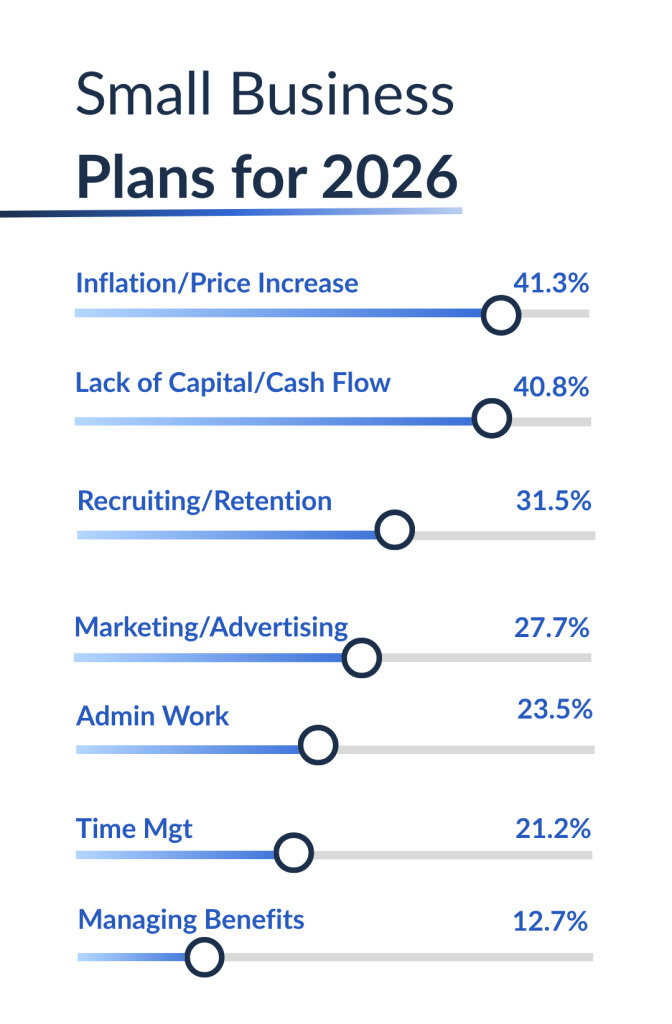
Biggest challenges of 2026 as reported in Guidant’s 2026 Small Business Trends survey.
Inflation remains one of the top concerns for small business owners heading into 2026. While the annual inflation rate has moderated from its 2022 peak of over 9%, new trade tariffs introduced in 2025 have injected fresh pricing pressure across supply chains, particularly for businesses reliant on imported goods and materials.
Small business owners continue to feel the squeeze: increased costs of goods and services, higher wages needed to attract talent, and uncertainty about the broader economic direction. In our survey, the top impacts of rising prices reported by owners included increased product/service costs, revenue loss, and pressure on wages.
But the news isn’t all bad. A strong majority of small businesses surveyed reported profitability this year, demonstrating the resilience of entrepreneurs who plan ahead.
Solution: Reduce and Renegotiate Expenses
Rising costs are a prime opportunity to audit your business expenses. Review service contracts, supplier pricing, subscriptions, and overhead, then negotiate or find more cost-effective alternatives. Even modest reductions compound over time.
For more inflation-fighting tactics, read Inflation-Proofing Your Small Business: Insights and Tactics From Successful Entrepreneurs.
2. Recruitment and Retention

The labor market has stabilized significantly since the height of the Great Resignation, and recent reports suggest that hiring has become somewhat easier for many small businesses. However, recruitment and retention remain a persistent top-three challenge, particularly for small businesses competing with larger corporations for skilled talent.
The challenge has evolved: it’s less about a shortage of applicants and more about finding the right fit at a price point a small business can sustain. Meanwhile, employee expectations around compensation, benefits, flexibility, and workplace culture have permanently shifted.
Solution: Compete on Compensation and Culture
To attract and keep quality employees, small business owners must think beyond base salary. Competitive benefits (especially health insurance) remain a top draw. Flexible scheduling, career growth paths, and a culture where employees feel genuinely valued are equally important levers.
Consistent employee recognition, whether through formal programs like employee of the month, spot bonuses, or regular one-on-ones, drives loyalty and productivity. Remember: the cost of replacing an employee far exceeds the cost of retaining one.
Looking to sharpen your hiring approach? See our guide on Hiring for Small Business 101: When and How to Find the Right Talent.
3. Lack of Capital/Cash Flow
Access to capital remains a central challenge for small businesses, particularly for those just starting out. Startup costs vary widely by industry, but the combination of elevated borrowing costs and more selective lending standards means that financing can be harder to secure than in previous years. At the same time, the 2026 Business Study reveals encouraging signs of entrepreneurial confidence. Nearly half of respondents launched their businesses with les
s than $250,000 in startup costs, demonstrating that business ownership remains attainable for many aspiring entrepreneurs. As business owners continue to adapt through careful planning and creative funding strategies, opportunities for growth and success remain within reach.
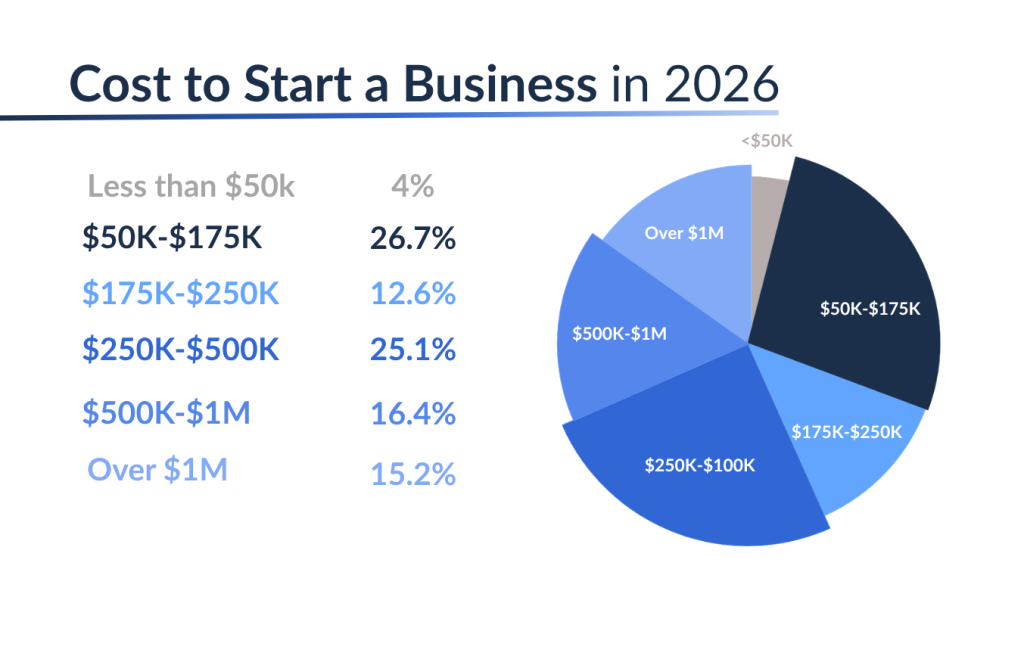
Average costs to start a business among small business owners surveyed in Guidant’s 2026 Small Business Trends study.
But even with today’s economic challenges, Americans created over ten million new businesses this year — so take heart and keep reading for what you can do to offset your lack of capital and cash flow.
Solution: Get Smarter Funding
Rollovers as Business Startups (ROBS) continue to be the most popular financing method among our survey respondents, and for good reason. ROBS lets you use your existing 401(k) or retirement funds to invest in your business, without incurring early withdrawal penalties or taking on debt. Guidant is the #1 ROBS provider in the U.S., and we’ve helped thousands of entrepreneurs fund their businesses this way.
Other strong options include Home Equity Lines of Credit (HELOCs), SBA microloans, and business lines of credit. Financing is rarely one-size-fits-all: the best approach depends on your personal financial situation, the type of business, and how quickly you need capital.
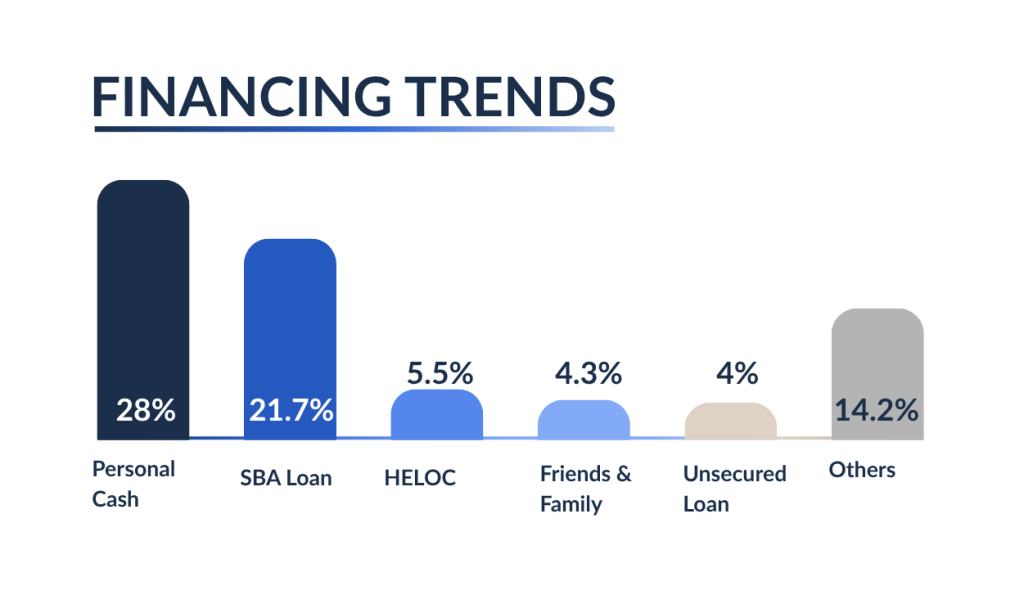
If other business challenges are stressing your capital and cash flow situation, you can also get creative with your solutions. Think about ways to pivot your business so it fits into a popular sector today. Some industries are even considered recession-proof.
How do you recession-proof your business? See the time-proven Top 5 Strategies for a Recession Proof Business.
Solution: Prioritize Cash Flow Management
Steady cash flow is the lifeblood of any small business. To keep it healthy: invoice promptly, offer early payment discounts, and consider requiring upfront deposits for large orders or projects. Closely monitoring your receivables cycle can prevent cash crunches before they happen.
4. Marketing and Advertising
Reaching the right customers in a noisy, fragmented media landscape remains one of the top challenges small businesses face. Marketing and advertising have also been transformed by artificial intelligence: AI-powered tools now make content creation, ad targeting, email personalization, and SEO optimization more accessible than ever, even for businesses without a dedicated marketing team.
The flip side: customers are also better at tuning out irrelevant messaging. Standing out requires authenticity, consistency, and a clear understanding of your target audience.
Solution: Define, Strategize, and Embrace AI Tools
Start by clarifying what marketing challenge you’re actually solving. Visibility? Customer retention? Driving traffic to your location or website? Each requires a different strategy.
A few practical approaches:
- Use AI tools like ChatGPT, Jasper, or Canva Magic Studio to produce content faster and at lower cost.
- SEO is still one of the highest-ROI investments for small businesses. A well-optimized blog and website help customers find you organically, without ongoing ad spend.
- Loyalty programs and text/SMS campaigns deliver strong ROI with minimal budget, especially for repeat-purchase businesses.
- If marketing is not your strength, outsource it. Freelance marketers and content creators are widely available and affordable.
Ready to level up your marketing game? Check out how to Market Your Business Successfully – no matter the economic climate.
5. Administration
Administrative tasks like bookkeeping, payroll, compliance, and HR paperwork are a significant drain on small business owners’ time and energy. These are non-negotiable functions, but they don’t have to consume your day. Mistakes in payroll or tax withholding can also carry steep penalties, making this an area where getting it right from the start matters.
The good news: automation and AI-powered software have made it easier than ever to handle these tasks efficiently, or to outsource them affordably.
Solution: Outsource or Automate
Dedicated bookkeeping and payroll services handle the heavy lifting: reconciliation, tax withholding, direct deposit, compliance filings, and more, so you can focus on running your business. Many also offer HR functions like time tracking, job description templates, and employee handbook support.
Guidant’s Payroll, Accounting & Tax, and HR services are built specifically for small businesses. We’ll handle the back office so you don’t have to.
6. Supply Chain Issues

Supply chain challenges have taken on a new dimension in 2025–2026. While the acute disruptions of the pandemic era have largely eased, the introduction of broad U.S. tariffs on imported goods has created fresh uncertainty for small businesses that depend on international suppliers, particularly in manufacturing, retail, and food service.
Higher import costs have been passed down the supply chain, and unpredictable pricing makes it difficult to plan inventory, set accurate prices, or commit to long-term supplier contracts. Businesses that built flexibility and redundancy into their supply chains are better positioned to weather the volatility.
Solution: Build Flexibility and Communicate Proactively
Practical steps to manage today’s supply chain environment:
- Monitor inventory closely. Know your lead times and reorder points. Supply constraints can develop quickly, especially for tariff-affected categories.
- Buy in bulk strategically. When pricing is favorable or shortages loom, stocking up on critical items reduces your exposure to future price spikes.
- Diversify suppliers. If possible, identify domestic or alternative international suppliers to reduce single-source dependency.
- Be transparent with customers. Let your customers know proactively if you’re experiencing delays or price adjustments. A heads-up via email or your website builds trust rather than damaging it.
7. Keeping Up with Technology and AI
A challenge that has rapidly climbed the ranks: staying current with technology, especially artificial intelligence. AI tools are reshaping nearly every function of a small business, from customer service chatbots and AI-written marketing copy to automated bookkeeping and demand forecasting. Businesses that embrace these tools gain a meaningful competitive edge; those that ignore them risk falling behind.
The barrier to entry is lower than many owners realize. Many AI tools are free or low-cost, require no technical background, and can deliver immediate time savings.
Solution: Start Small and Build From There
You don’t need to overhaul everything at once. A few high-impact starting points:
- AI writing tools (ChatGPT, Claude, Gemini) can draft emails, blog posts, social captions, and customer responses in seconds.
- AI scheduling and CRM tools reduce administrative overhead and help you stay on top of leads and follow-ups.
- Automated bookkeeping software like QuickBooks or FreshBooks can flag anomalies, categorize expenses, and generate reports with minimal manual input.
The key is to identify one or two repetitive tasks in your business and explore whether an AI tool can handle them. Small wins build confidence and momentum.
Get a Little Extra Help from the Pros
Small business ownership isn’t easy, but the entrepreneurs who stay informed, adapt quickly, and build strong support networks consistently come out ahead. Whether you’re tackling inflation, navigating financing, or figuring out how to use AI in your operations, you don’t have to do it alone.
Guidant Financial is dedicated to helping small businesses at every stage: from funding your startup with ROBS or SBA loans, to managing your Payroll, Accounting & Tax, and HR needs as you grow. We provide mentorship through every stage of your business’s life, so don’t let today’s challenges get you down!
Call us today to find out how we can help you achieve your small business dreams at 425-289-3200.

“[Working with Guidant] is going to save you a ton of time, frustration, and paperwork in the business.”
— Mike Brown, the Flying Locksmiths
Read Guidant’s Client Success Stories.