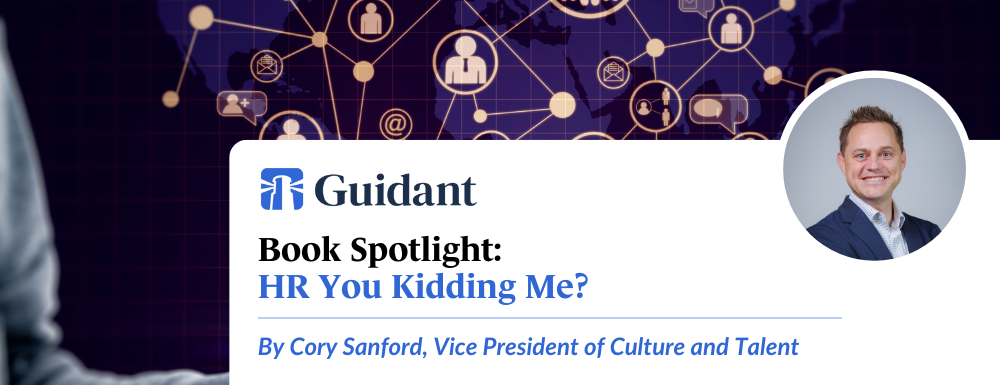
Are you a business owner looking for fresh ways to build a workplace culture that reflects your values—one that’s simple, energizing, and effective—and that actually drives performance, growth, and real business outcomes? Maybe you’re juggling leadership responsibilities with outdated HR advice that no longer fits the needs of a modern team. If that sounds familiar, Cory Sanford’s debut book, HR You Kidding Me?: Surprisingly Simple Steps to Unlock the Power of People—a #1 Amazon bestseller—might be the resource you’ve been looking for to move your business forward and help your team hit its goals.
Cory is the VP of Culture and Talent at Guidant Financial, as well as an international speaker and HR consultant. His book offers a bold, energizing perspective on how HR can evolve to meet today’s challenges. With a blend of humor, real-life stories, and over a hundred practical tips, Cory equips HR professionals, entrepreneurs, and business leaders with tools to build company cultures where people — and performance — thrive.
These aren’t just big ideas on paper. The principles in HR You Kidding Me? have helped multiple organizations earn #1 Best Places to Work honors by fostering high-performing, people-centered cultures. As David Nilssen, CEO of DOXA Talent, shares in the foreword, Cory’s ability to balance protecting the organization while nurturing its people makes his approach both practical and deeply human. It’s about unlocking potential — helping teams show up, do their best work, and feel their best while doing it.
Here’s just a sample of what you’ll find in HR You Kidding Me?:
1. Leadership techniques that actually work.
2. Tips on how to hire for culture and not just skills.
3. Secrets to effective onboarding and offboarding.
4. Strategies for transforming your company culture.
5. Tools to sharpen your HR practices for the new workforce.
Cory also recently joined Maxio CEO Randy Wootton on the podcast episode Culture is Connection: How to Empower Your Team with Purpose, where he shared more insights from the book. In Cory’s words:
“I wrote this book for the person in the small company where people are wearing many hats, including the Human Resources function, for the brand new supervisor, and for experienced HR and business leaders alike. There is something for everyone.”
Let’s take a closer look at what Cory has to say:
–
Working with Guidant Financial
Cory begins by sharing his experience at Guidant Financial, where he helps entrepreneurs start and grow their businesses by managing back-office functions like payroll, bookkeeping, and small business financing. A major part of that work includes helping new business owners access their retirement savings through 401(k) business financing — also known as Rollovers for Small Business Startups (ROBS) — so they can launch their companies debt-free.
“We like to say we’ll take on the paperwork so companies can take care of their purpose and their people and their business,” Cory explains. With over $5 billion deployed into the economy and 8,000 active clients, Guidant doesn’t just view small business owners as customers — they see them as “dreamers” who form the backbone of the American economy.
Shifting into lessons on leadership, Cory emphasizes the CEO’s essential role as a culture-builder. While HR can serve as a guide, it’s the CEO who must define a company’s values and embody them every day. “The CEO’s responsibility is to set clear values and principles and then be the ultimate example of living those company values and principles,” he says. One of the ways Guidant reinforces this commitment is through weekly stories of employees living out company values, which are shared across the organization. These moments of recognition help keep the culture alive — and build a stronger sense of appreciation along the way.
Another powerful leadership insight Cory shares: great CEOs don’t always have the answers — but they ask the right questions. “The higher up you get in an organization, the skill set shifts from needing to have all the answers to needing to have the best questions,” he says.
He also shares a philosophy inspired by Guidant CEO Jeremy Ames: “As leaders, we need to have strong opinions held loosely.” It’s a mindset that blends confidence with humility — one that helps teams stay focused on their mission while staying open to change.
–
Creating a Strong Cultural Alignment
Another key topic Cory explores in both his book and the podcast is how to measure company culture. At Guidant, he faced a pivotal challenge a few years ago: transitioning the organization to a fully remote model. That shift revealed a problem — the traditional ways of defining company culture felt too abstract, too vague to be useful in a distributed workplace.
To solve that, Cory reframed the idea of culture into something more tangible: connection. More specifically, connection to the organization’s purpose, its leaders, and to one another. This simple but powerful redefinition turned culture into something measurable — and actionable.
With this new lens, Guidant began using regular employee surveys to assess how connected team members felt in each of those three areas. The results became a blueprint for meaningful changes — driving improvements to employee well-being and reinforcing a strong, positive workplace culture in a fully remote environment.
–
Leaning into Leadership
Cory continues to emphasize leadership as the cornerstone of workplace culture, especially the relationship between employees and their direct supervisors. At Guidant, that belief translates into a strong investment in leadership development — with a focus on regular, intentional one-on-one meetings that create space for growth.
“There’s no silver bullet in leadership — the closest thing is effective and regular one-on-ones,” Cory says. These conversations open the door to goal setting, coaching, discovery, and feedback — all of which play a huge role in keeping employees engaged and aligned.
To foster peer connection in a remote environment, Guidant took a creative approach. They launched a “Break Room” channel on Microsoft Teams, giving employees a virtual space to chat casually, celebrate personal milestones, and stay socially connected. New hires are paired with a “Partner in Crime” to help ease the transition and immediately build rapport. On a broader level, Guidant supports connection through two dedicated employee committees — one focused on connection, opportunity, and growth, and another committed to diversity, equity, and inclusion — both of which strengthen belonging across the company’s global team.
Cory also brings a refreshing simplicity to performance management. Instead of relying on complicated systems or rigid review cycles, Guidant uses a single-page Word document for both self-assessments and supervisor feedback. The point isn’t to check a box — it’s to create space for real conversations. “Rather than focusing so much on just the mechanics, we focus on the intent of the conversation — celebratory, inspiring, and future-focused.”
By breaking culture down into measurable connections and emphasizing thoughtful, human-centered practices, Guidant has built a thriving remote-first culture. And behind it all is Cory — helping turn intentional leadership into a way of life.
–
Taking a Deeper Dive
If you want to read Cory’s book or watch the full podcast for more of his insights on effective communication, HR training programs, employee satisfaction, and workplace culture, you can purchase HR You Kidding Me? and view the podcast. With Cory’s words of wisdom, you should be well on your way learning how to create a positive company culture and employee experience while meeting your company goals.