Entrepreneurs eager to transform their dreams into reality often overlook a powerful yet underutilized resource already at their disposal – 401(k) business financing, also known as Rollovers for Business Startups (ROBS). This innovative funding solution not only taps into your retirement savings but does so without the penalties and debts typically associated with business loans, providing a fresh, financially savvy way to kickstart your venture.
What is 401(k) business financing, also known as Rollovers for Business Startups (ROBS)? Get the full breakdown here.
The Advantages of 401(k) Business Financing

401(k) business financing, also known as Rollovers for Business Startups (ROBS), lets you harness the power of your own nest egg. This versatile and underutilized tool goes beyond just 401(k)s to include traditional IRAs, Thrift Savings Plans (TSPs), and more. How does it work? In short, this method leverages your tax-advantaged retirement funds, allowing you to launch or expand your business without the burden of debt. By sidestepping monthly loan payments, you free up essential cash flow – a lifeline for any fledgling business.
For entrepreneurs who have faced credit challenges in the past, this financing option shines. It eliminates the need for a high credit score or collateral – requirements that often pose barriers with traditional lending avenues. Say goodbye to the risk of tying your home or other personal assets to your business’s fortunes.
ROBS also smartly bypasses hefty taxes and early withdrawal penalties that would eat into your funds if accessed directly. Normally, tapping into these accounts before age 59½ triggers a 10% penalty from the IRS, plus taxation at your current rate. With this strategy, you preserve the full strength of your retirement savings to power your business dreams, tax and penalty-free.
But just as it offers many benefits to entrepreneurs, 401(k) financing can be complicated. It needs to be done in the right way to avoid taxes and penalties, and it needs to follow government rules and regulations on an ongoing basis. You also need to know the principles that are more likely to optimize the funds you withdraw. Here is an overview of five key factors to consider before utilizing 401(k) business financing:
Despite having “401k” in the name, you can use most retirement plans for ROBS! Here are the 10 types of eligible retirement funds you can use with ROBS.
1. Start With At Least $60,000
ROBS or 401(k) business financing can be used to fund nearly any aspect of your business, from purchasing equipment or real estate to operating expenses to franchise fees. But it’s advisable to have at least $60,000 from tax-advantaged funds to invest in your business. With that amount, you can use the money optimally for your business. Smaller amounts might not provide sufficient capital for launching or sustaining a business.
As you explore the possibilities of 401(k) financing, it’s crucial to have a clear picture of your total financing needs. One of the standout features of ROBS is its collaborative potential. Not only can you tap into your retirement funds, but your partners can join the venture too – pooling resources for a stronger financial foundation. To make the most of this opportunity, each partner should be ready to invest a minimum of $60,000.
It is also possible to combine ROBS funding with loans, such as a U.S. government Small Business Administration (SBA) loan.
2. You Must Be an Active Employee of Your Business
Government regulations require anyone who utilizes 401(k) funding for a business to be an active employee of the business. You cannot, for instance, be a passive investor in it. You must have a defined role and title with a commensurate salary if your business profit can support a salary. (If it can’t initially, you need to begin drawing one as soon as it can.) You also need to work at least 500 hours annually (about 20 hours per week) in the new company to meet government regulations for 401(k) financing.
It’s helpful to realize that these requirements could necessitate leaving your current employment.
Relatedly, if the tax-advantaged funds you intend to use for ROBS funding are with your current employer, you may have to leave before you can use them. Any retirement funds used with 401(k) funding must be completely rollable to your new company, which in most cases means you must no longer be employed with the company they come from.
3. Your Business Must Be a C Corporation
401(k) business financing requires that your company be a C Corporation (C Corp). What does that mean? Well, every business must choose one of several possible entity structures when it is formed. (The possibilities are sole proprietorship, partnership, limited liability company, S Corporation or C Corporation.) The entity chosen affects key elements of your business, such as the taxes owed and liability from lawsuits and other liability.
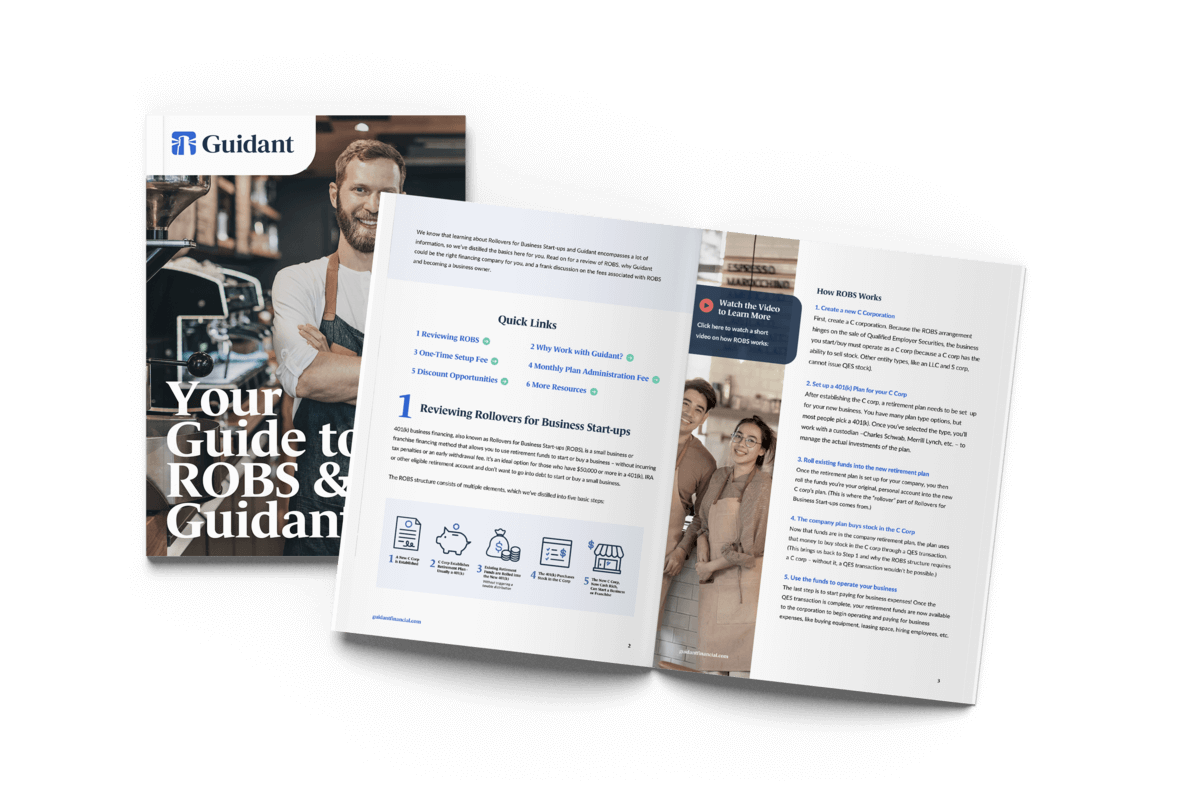
Why does 401(k) financing require a C Corp? Because of the way the rollover must be set up to ensure that your tax-advantaged funds don’t incur taxes and penalties. Briefly, you set up a new C Corp. Then, you create a tax-advantaged retirement plan for all employees, including yourself. Usually, this is a 401(k) plan, but other types are possible. Once that plan is set up, the retirement funds you want to fund the company with are rolled into it.
At that point, the plan purchases stock in your new company. It uses a Qualified Employer Securities (QES) transaction to do so, which is possible only via a C Corp, not with the other entity types. Once the QES transaction is completed, the funds will be available to the company for any purpose.
While the rollover method is the primary reason your business must be a C Corp, you also need to understand the responsibilities that come along with a C Corp. C Corps must, for example, offer publicly traded shares. They must make public reports of their finances in annual reports and have a board of directors.
Curious about how C Corps work? Learn everything you need to know about C Corps here.
4. Understand the Ongoing Compliance and Administrative Responsibilities
Utilizing a ROBS structure for funding brings with it ongoing compliance and administrative responsibilities. It’s important to know what these are and keep up with them; otherwise, your business could incur additional taxes, fines and penalties.
First, you are the Plan Administrator for the 401(k) or other tax-advantaged retirement plan that is set up as part of the ROBS transaction. It must meet all Department of Labor (DOL) and IRS laws and requirements, which can be quite stringent.
One major requirement is the filing of a Form 5500, Annual Return/Report of Employee Benefit Plan, every year with the DOL and IRS. In order to do this, you have to make sure that the appropriate reviews and reporting on the retirement plan is done in a timely manner every year. An Annual Plan Report and Statement of Value must be completed, detailing the plan’s assets and other key information. This necessitates a yearly business valuation, a census of employees and financial reporting.
In addition, you must file and pay all applicable taxes to the IRS because your new company is a C Corp. This includes estimated taxes on the company’s profit every quarter and a final filing at fiscal year-end, as well as your own individual taxes from your salary. Note, of course, that you will also be responsible for filing any other applicable taxes, such as state and local.
5. Work With an Experienced 401(k) Provider
As you can tell by points one through four, the requirements of 401(k) financing can be complicated. It’s crucial to know the importance of working with an experienced ROBS provider to navigate legal and governmental requirements and complexities. Without it, you can be exposed to fines, penalties, and even legal action.
An experienced ROBS provider can:
- Help you navigate multiple laws and requirements.
- Help you prepare Form 5500 and the multiple documents that support it, such as the financial statements, statements of value and employee census.
- Help you file an Employee Retirement Income Security Act (ERISA) Fidelity Bond, which is mandated for all 401(k) plans that contain QES.
No matter which ROBS provider you choose, it’s important to have one by your side to ensure that your 401(k) financing is initiated correctly and administrated correctly every year to maintain the health of your business.
Looking for a ROBS provider? Here’s a guide on how to pick the right one for you.
Let Guidant Help You and Your Business
Guidant Financial is the leading ROBS provider in the United States. If you’re considering using your 401(k) to fund your business, we’re here to guide you through every step. Our team will explore the potential of 401(k) financing to ensure it aligns perfectly with your goals. With a track record of empowering over 30,000 small businesses with more than $6 billion in funding, we’re not just participants in your journey – we’re committed partners dedicated to crafting a funding strategy that helps you create the life you’ve always wanted.
Once you secure ROBS funding, Guidant doesn’t just send you on your way – we stay by your side. Our Plan Administration Service is specifically designed to lift the burden of complex administrative duties off your shoulders. We’ll help you prepare and compile all the necessary paperwork, ensuring every detail is accounted for.
But why stop there? Our Bookkeeping & Tax Service offers comprehensive tax and bookkeeping support to streamline your financial operations. From preparing detailed financial reports to ensuring timely tax filings, we’ve got you covered, allowing you to focus on what really matters – growing your business.
Navigating the intricacies of funding and managing a small business can be daunting. Let Guidant Financial help simplify the process.
Call us today at 425-289-3200 for a free, no-pressure business consultation to get started — or pre-qualify in minutes for business financing now!

“If you’re committed to it and you have a vision, then Guidant is the way to make it come to life.”
— Marc Warner, Bovine Burgers
Read the stories of REAL small business owners who work with Guidant.